
Friday, January 17, 2014

Sunday, January 12, 2014
Larry's Cartoon Vault: Comic Postcards
When was the last time you mailed a postcard?
In our continuing documentation of the demise of print media, the postcard may be another form of cultural ephemera you can kiss good-bye.
In our continuing documentation of the demise of print media, the postcard may be another form of cultural ephemera you can kiss good-bye.
Aside from the ‘Wish-you-were -here” school of photo landscapes and sites there’s been a long tradition of comic and novelty postcards – often topically funny, lurid, risqué and sometimes just plain strange.
Here from the Vault are some true oldies by three of the
most renowned cartoonists of the late 19th and early 20th
century.

R.F. Outcault- creator of what is commonly held to be the first
comic strip The Yellow Kid and creator of the once enormously popular Buster
Brown drew these in 1905.


Frederick Burr Opper
 |
| Opper by Opper |
 |
| Opper's most famous creation, Happy Hooligan, 1906 |


F.M. Howarth- a
mainstay of humor rags such as Puck and Life created the strip Lulu and Leander in 1903.


Some of the above cards (the ones with sepia hued phantom images) by both Opper and Howarth are “Magic Cards” produced by Hearst
papers as a promotion circa 1906.
The “punchline” was invisible and required the viewer to “run a hot flat iron over the back of these postcards or hold them over a gas jet, or a lamp, or a burning match (but be careful not to set them on fire)---and see what happens”.
By doing so the punchline image would be obtained (along
with a few burnt fingers perhaps).
Numerous other cartoonists drew cartoon postcards including
the renowned Clare Victor Dwiggins aka Dwig.

And the unknown (to me anyway) Myer.

On the other hand some cartoonists specialized in comic
postcards. Three figures who dedicated a great deal of the creative
career to cartoon postcards are below : Walter Wellman, Donald McGill and the
nearly feral Hillbilly Larry Smith.
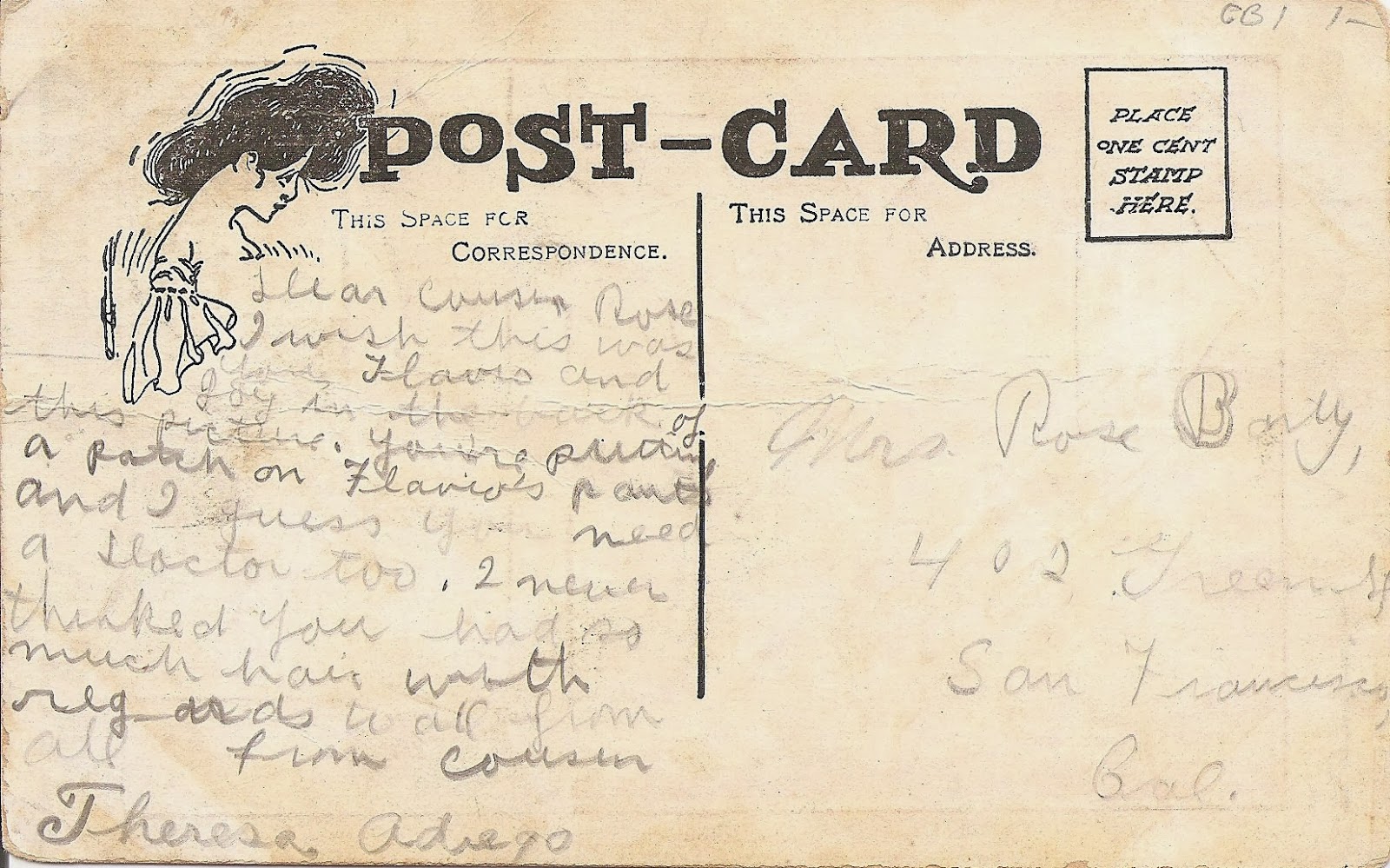
Walter Wellman drew cartoon postcards, comic valentines and novelty
cards of all sorts for decades.
 |
| 1908 |
 |
| Reverse |
Here’s an original drawing from my collection by Wellman. It appears to be an
incomplete drawing for a postcard drawn probably sometime before WWI.

British artist, Donald McGill usually specialized in vulgar and racy
(by British standards of the day) cards that were hugely popular in England. Apparently there’s a Donald McGill Postcard
Museum in England.
 |
| A tame McGill card circa 1924 |
Hillbilly Larry Smith often bartered cartoon drawings for
hamburgers and beer.
He also drew a lot of postcards like these:


This black and white one was used by Smith himself back in 1944 just as he was being discharged from the military.

And another one


Somebody probably has written a history of the comic
postcard but I’ve never seen it. Here’s a sort of bibliography for the three cartoonists I’ve
just featured.
The Postcard Collector
magazine v8 #11 Nov. 1990 Features a brief account on Walter Wellman.
The World of Donald
McGill by Elfreda Buckland, Blanford Press 1984
The Brass Ring by Bill Mauldin (Mauldin describes the colorful Hillybilly
Larry in this memoir—the first cartoonist Mauldin ever met).
Saturday, January 11, 2014
Senior Lunch Group Art Show
The show for January at the San Geronimo Valley Community Center is an exhibit of artists that attend the weekly senior lunch.
Fortunately the San Geronimo Valley has an inordinate number of talented artists which makes this show a lot of fun to put on.
Here's a very small sampling of work from the exhibit.
This is the 4th Annual Senior Lunch Group Art Show.
The art reception is tomorrow, Sunday, January 12th, 4-7-m
at the San Geronimo Valley Community Center.
Fortunately the San Geronimo Valley has an inordinate number of talented artists which makes this show a lot of fun to put on.
Here's a very small sampling of work from the exhibit.
 |
"Anonymous" mixed media by Al Ardelle
( image copyright 2014 Al Ardelle) |
 |
| "Fair Enough" by Laura Kradjan-Cronin |
 |
| "Stairway to Heaven" ceramic by Christina Jaqua |
 |
| "A Match Made in Heaven" ceramic by Christina Jaqua |
This is the 4th Annual Senior Lunch Group Art Show.
The art reception is tomorrow, Sunday, January 12th, 4-7-m
at the San Geronimo Valley Community Center.
Tuesday, December 31, 2013
Happy New Year !

Art from the 1921 end of the year edition of Life drawn by Molly's grandpappy, Rea Irvin.
Friday, December 27, 2013
Larry and Molly's Annual Post-Christmas/ New Year's Card


Merry post-Christmas and a Happy New Solar Cycle !
Wednesday, December 25, 2013
Larry's Cartoon Vault: The Cartoon Ghosts of Christmas Past
A little holiday cheer from three classic humor weeklies of days gone by.

Cover from Ballyhoo 1934. Artwork by Russell Patterson.


Two cartoons by the ever zany Bill Holman from Judge 1931.
And J.R. Shaver from Life 1921.

Merry Christmas from Larry and Molly!
Tuesday, December 17, 2013
Larry's Cartoon Vault: Art Young and the Espionage Act
Reading a news item recently
regarding national security issues, I was surprised to learn that the Espionage
Act was currently being used to prosecute government employees for leaking
classified information to journalists.
In my innocence, I was somewhat surprised to learn
that the Espionage Act --enacted in 1917-- was still in existence at all. I only knew of the law in association with a series of infamous trials during World War I.
For me, the term “espionage”
conjures up images of invisible ink, secret passwords, spies thwarted from
blowing up the Brooklyn Bridge or some such.
However, the case I’m most
familiar with from the WWI era had to do with the activities of a “dangerous”
cartoonist who used very visible India ink.
Art Young.
Art Young.
 |
| Self portrait from Art Young's Inferno (1934) |
Young was one of a number of artists and
writers who were placed on trial for conspiring to obstruct
military enlistment under the Espionage Act.
Young, a well-known and
successful cartoonist, had a career that began around 1889. He worked for a variety of newspapers and
freelanced to major humor magazines such as Puck, Life and Judge. He drew straight
gags, social satire and progressive political cartoons. He also was a frequent
contributor the Socialist magazine, The Masses (many of the finest cartoonists,
illustrators and artists of the day contributed to The Masses including John
Sloan, George Bellows, Robert Minor, Broadman Robinson and Robert Henri).
The Espionage Act was originally
enacted on June 15, 1917 to prevent the support US enemies during times of war. During WWI, the Espionage Act
was broadly interpreted to include pretty much any criticism of Woodrow Wilson administration’s war efforts.
Below is "Exhibit F" in Art
Young’s trial for sedition:
 |
| "Having Their Fling" |
It’s hard today to imagine
that an editorial cartoon that disapproves of war so generically could be viewed
as a kin to an act of violence or sedition.
Somewhere along the line a
law intended to thwart foreign subversion –like blowing up the Brooklyn
Bridge—was instead being employed to censor the press.
Young’s take on the proceedings was remarkable:
“… I did not expect to be
hung if found guilty, or shot at sunrise. At the worst I was sure it would be
but a few years in prison.” (Italics
my emphasis).
He may be best remembered
for falling asleep during the “trial for his life”.
 |
| Young later did this sketch of his famous nap. |
Among other writers and
artists tried at the time included editor Max Eastman, H.J. Glintenkamp, John Reed
and even poet Josephine Bell (she wrote a poem about Emma Goldman).
Ultimately, the jury split and the judge called a mistrial. On Oct 1918, a second trial for
conspiracy was held. Again resulting with a split jury.
Art Young, a great cartoonist, is unjustly forgotten today.
Here’s one of my favorite Young cartoons (actually one of my favorite cartoons, period)

Here's a couple more:
 |
| This was one of Young's most reprinted cartoons |

For more on the subject
check out these books by Art Young:
On My Way
Art Young: His Life and Times
Art Young’s Inferno
The Best of Art Young
and:
Art for the Masses by
Rebecca Zurier
Friday, December 6, 2013
Nelson Mandela 1918-2013
Thinking of the remarkable Nelson Mandela. Here is a cartoon by South African cartoonist, Zapiro, done some years ago (2003) but still rings true. A great moral leader.


From Zapiro's book Dr.-Dolittle and the African Potato
Tuesday, December 3, 2013
Hand Carved Bobbleheads by Mot
Marin artist, Mot, recently made these bobble heads of the Fab Four, Bill Shakespeare and some Dead guys. They are hand carved from wood and hand painted. Mot will be selling wooden toys and other such items at the Holiday Crafts Fair at the San Geronimo Valley Community Center on December 7th.

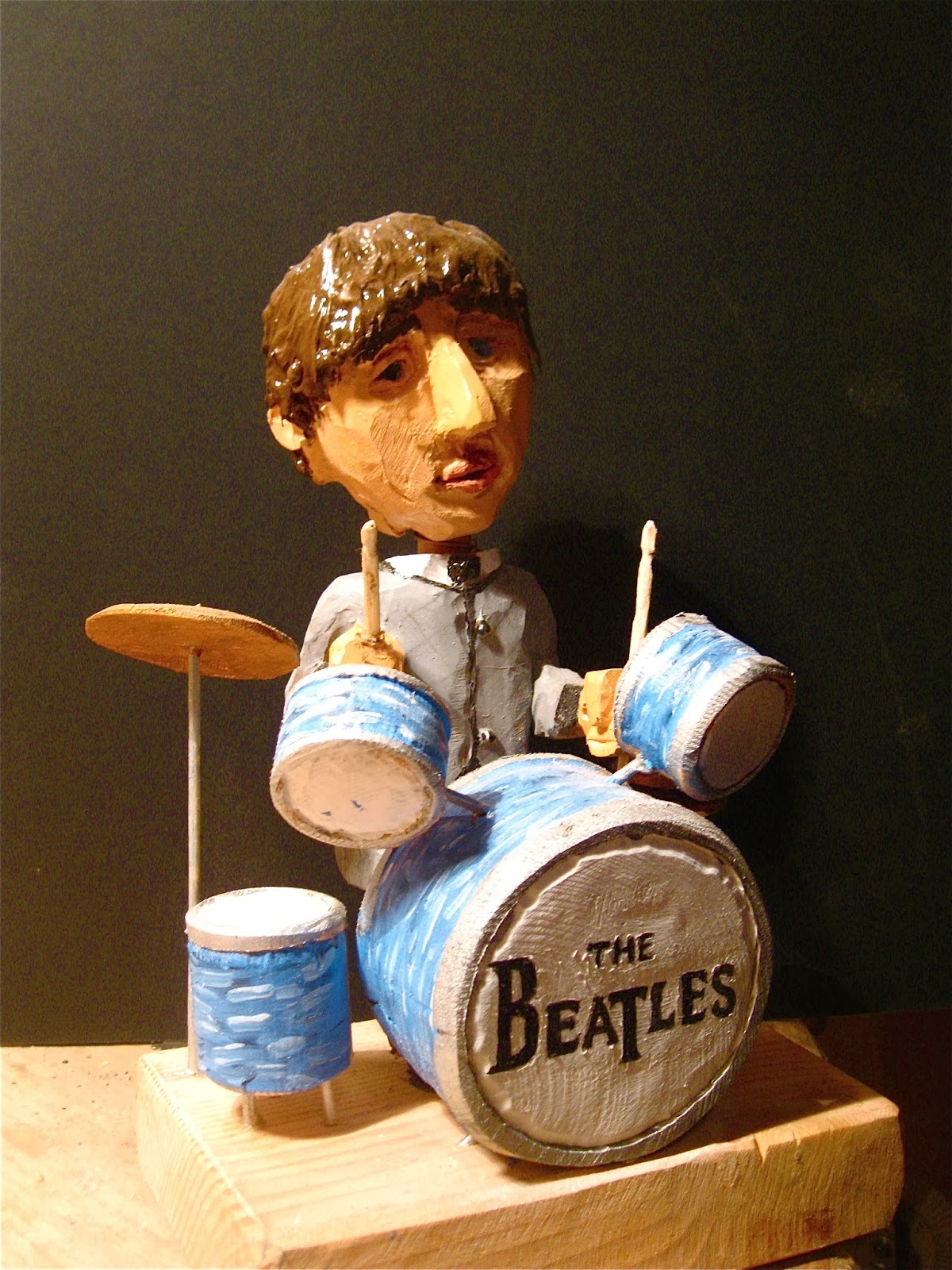


Thanks to Mot for the snaps. You can find more on Mot on previous posts on this blog (check the Search) or take a gander at his website www.motartstudios.com
Thanks to Mot for the snaps. You can find more on Mot on previous posts on this blog (check the Search) or take a gander at his website www.motartstudios.com
Sunday, December 1, 2013
Last Show of the Year at SGVCC
We just concluded the last exhibit for the year 2013 in the Maurice Del Mue Galleries at the San Geronimo Valley Community Center.
The November show was a retrospective of the work of the late dancer, calligrapher and painter, Jenny Hunter Groat (1929-2013).


The November show was a retrospective of the work of the late dancer, calligrapher and painter, Jenny Hunter Groat (1929-2013).
 |
| Jenny circa 1960's |
 |
| Jenny's calligraphy |
 |
| Lacuna |

Peter Groat, Jenny's husband, conducted a talk on Jenny's work at the reception.

The reception was held on November 10th.
Subscribe to:
Posts (Atom)